
A higher capacity rating doesn’t automatically make a crusher the right primary unit. For jaw-versus-cone crusher selection in Zambia’s copper processing, jaw crushers commonly take the primary role on large, hard feed, while cone crushers are commonly used for secondary and tertiary crushing. Stated upper capacities reach about 1,500 tonnes per hour for jaw crushers and about 3,000 tonnes per hour for cone crushers.
Start with the required throughput, but do not choose on capacity alone. Feed size, ore characteristics and target product size determine whether a crusher will suit the duty.
This comparison explains how jaw, gyratory, cone and impact crushers differ in application, primary crushing roles and processing capacity. You’ll see how to match each option to the feed and crushing stage, then use a practical decision guide for a copper-processing circuit in Zambia.
Key Takeaways
- Match crusher choice to ore hardness, abrasiveness, moisture and the product size required by the next processing stage.
- Assess gyratory crushers for continuous, high-throughput duties; their operating role differs from the intermittent crushing action of a jaw crusher.
- Consider impact crushing for suitable lower-to-medium-hardness material, while accounting for wear and the need to control foreign metal in the feed.
- Compare capacity in the context of the full crushing circuit, including feed conditions and whether screening operates in an open or closed circuit.
What are the key differences between a jaw crusher, gyratory crusher, and cone crusher in terms of application?
Choose a crusher by matching ore characteristics and feed size to the required product. Jaw crusher versus cone crusher selection for copper processing in Zambia also depends on throughput, the number of crushing stages, moisture and whether the circuit is open or closed.
A jaw crusher breaks large feed between fixed and moving plates, so it is commonly used for primary crushing. Gyratory crushers suit continuous, high-throughput primary duties. Cone crushers typically reduce sized feed at secondary or tertiary stages, refining particle size and often producing a more cubical product.
| Crusher | Typical application | Feed and product consideration |
|---|---|---|
| Jaw | Primary | Large, hard feed; fewer fines |
| Gyratory | High-throughput primary | Continuous crushing |
| Cone | Secondary or tertiary | Sized feed; controlled gradation |
| Impact | Primary or secondary | Lower-to-medium hardness; more fines |
Choose equipment that meets the circuit’s feed and product requirements without adding an unnecessary crushing stage.
For hard, abrasive copper ore, a jaw crusher suits primary reduction, while a cone crusher suits later crushing. Copper ore is also suitable for cone crushing; impact crushers can wear quickly on hard rock.
Energy use varies by crusher and operating conditions, so compare expected consumption for the specific application. Operating costs still depend on feed, wear parts, and downtime. Cone liner replacement can require 6-8 hours of downtime.
At mine sites in Zambia, operating procedures should address dust, noise, guarding and safe access. Match controls to the crusher’s location and the task.
Crusher availability depends in part on access to compatible wear parts and maintenance support. Before selecting a machine, consider parts sourcing, lead times and planned access for servicing.
For a copper-processing project in Zambia, assess power supply, transport routes, installation space and feed characteristics. These factors affect equipment configuration and circuit layout.
Gyratory crushers can use hydraulic setting adjustment to regulate discharge gradation. Cone crushers operate at higher speeds and use a different chamber geometry to achieve finer size reduction.
Jaw crushers for primary crushing
Primary crushing is the first size-reduction stage in a copper circuit. A jaw crusher uses a fixed plate and a reciprocating moving plate to break run-of-mine ore. Its discharge can travel by conveyor to a secondary crusher, such as a cone crusher, for further reduction.
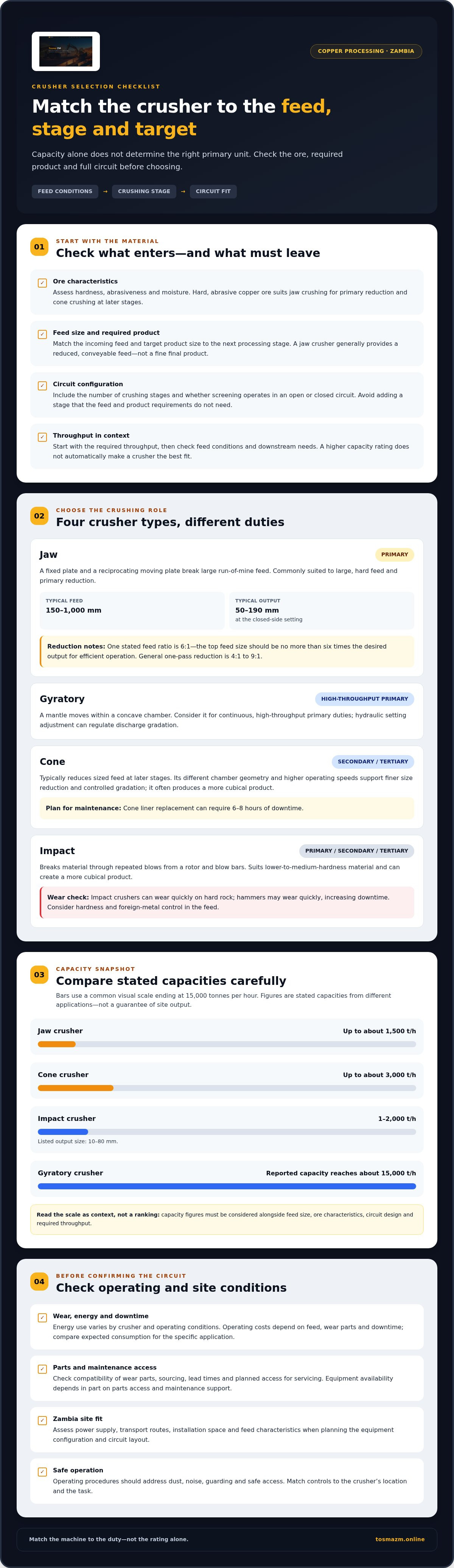
Jaw crushers suit hard, abrasive, and sticky feed, including copper ore. Typical feed measures 150-1,000 mm, and one stated feed ratio is 6:1. That ratio means the top feed size should be no more than six times the desired output size for efficient operation. Jaw crushers generally reduce material at a 4:1 to 9:1 ratio in one pass.
For a smaller or medium-scale mine, a jaw crusher can provide the primary break before secondary and tertiary stages. Its reciprocating action handles large rocks, while the resulting fragments move onward for further reduction. A typical output range is 50 mm to 190 mm at the closed-side setting. This makes the jaw useful where the next stage needs a reduced, conveyable feed rather than a fine final product.
Large copper mines may use a gyratory crusher for primary duty when continuous, high-throughput crushing is required. Gyratory units crush between a conical head and concave surface. Reported capacity reaches about 15,000 tonnes per hour, though the circuit’s required throughput determines whether that scale fits. A jaw crusher offers a different primary configuration, particularly where its feed handling and output suit the plant layout.
Choose the primary machine by comparing feed size, ore hardness, target discharge, and the capacity required by downstream stages. For aggregate production, a jaw-and-impact line can use the jaw for primary reduction and impact crushers for secondary shaping. Impact crushing can create a more cubical product, but hard-rock wear must be considered. For crusher procurement planning, use crusher supply information to support equipment decisions.
Jaw, gyratory, cone and impact crusher roles
Crusher selection for a copper-mining circuit starts with the breakage method and feed condition. Jaw, gyratory and cone crushers use compression, crushing material between surfaces. Impact crushers break material by striking it. The method affects suitable applications, product shape, wear and the reduction required at each stage.
A jaw crusher suits primary duty when large run-of-mine rocks need initial reduction. Gyratory crushers also serve primary applications, particularly in large plants requiring continuous throughput. A gyratory crusher’s mantle moves within a concave chamber, and hydraulic setting adjustment can regulate discharge gradation. Cone crushers use compression in a different chamber geometry and commonly handle secondary or tertiary crushing.
Impact crushers break particles through repeated blows from a rotor and blow bars. Depending on material and circuit design, they can serve primary or secondary duties. Horizontal-shaft impact machines cover primary, secondary, or tertiary applications; vertical-shaft units are used for final shaping when a cubical product is required. Listed impact-crusher capacity ranges from 1-2,000 tonnes per hour, with output sizes of 10-80 mm.
Cone crushing is suitable for hard, abrasive copper ore. Impact crushers are generally better suited to low- or medium-hardness feed; on hard rock, their hammers can wear quickly, increasing downtime. Feed hardness and wear exposure are therefore central to deciding whether impact crushing is appropriate. In recycling, impact equipment may suit more manageable feed, but material properties and product requirements still matter.
- Use compression stages when hard, abrasive ore needs controlled reduction.
- Consider impact crushing when the feed hardness and desired final size suit the machine.
- Match the crusher setting and downstream screening to the required particle-size distribution.
Jaw and cone crusher processing capacities
Jaw crushers suit primary feed, while cone crushers commonly handle secondary and tertiary duties. Stated upper capacities are about 1,500 tonnes per hour for jaw crushers and 3,000 tonnes per hour for cone crushers.
Jaw crushers have a typical one-pass reduction ratio of 4:1 to 9:1 and an output range of 10-350 mm. Cone crushers generally achieve a 6:1 to 8:1 single-pass reduction ratio, with gradation controlled through the closed-side setting.
Jaw Crusher Processing Capacity
A jaw crusher’s listed capacity reaches about 1,500 tonnes per hour, but feed size and crusher configuration affect actual throughput. Its 4:1 to 9:1 reduction ratio and 10-350 mm output range make it suited to primary reduction, rather than fine product sizing. Match the discharge to the next stage’s feed requirements.
Cone Crusher Processing Capacity
Cone crusher capacity varies by model and operating conditions, so compare rated throughput with the requirements of the circuit. Its 6:1 to 8:1 single-pass reduction and adjustable closed-side setting support controlled product gradation. Cone crushers commonly serve secondary or tertiary crushing, preparing material for grinding rather than taking oversized primary feed.
For jaw crushers and cone crushers, compare capacity, reduction ratio, and product size together. A higher rated capacity does not settle the choice: the feed condition, required throughput, and target gradation determine whether the machine fits the circuit. Gyratory crushers serve a different scale, with listed capacity reaching about 15,000 tonnes per hour.
Check the design against the full production path. Confirm that the primary crusher’s discharge suits the cone feed, and that screening returns oversize material when a closed circuit is required. Cone efficiency drops when feed moisture exceeds 5%, so wet feed can restrict throughput. Wear part access and planned downtime also affect sustained production.
For a copper circuit, select capacity around anticipated production and the required mill feed size, not the largest rating alone. Review mining equipment options when planning crusher procurement.
Tosma ZM: Construction Supply
Once crusher selection has clarified the equipment requirements for a copper-processing project, Tosma ZM can support procurement through its Mining Equipment and Construction Supply offerings. Use the operating criteria in this comparison, including feed size, throughput, crushing stages and target product gradation, to prepare a clear equipment brief.
Construction Supply supports related project requirements, while Mining Equipment covers mining machinery procurement. Vehicles & Fleet may also be relevant when transport assets are part of the procurement scope. Tosma ZM supplies equipment and related goods, rather than providing mining operations or equipment maintenance. Contact Tosma ZM to discuss procurement against your project requirements.
Turn crusher selection into a procurement brief
Before settling on a crusher configuration, turn the process requirements into a clear equipment brief. Record the feed characteristics, target product, expected throughput, circuit arrangement and site constraints. This gives procurement a practical basis for comparing options and planning connected equipment needs.
A considered approach to jaw crusher versus cone crusher selection for copper processing in Zambia keeps the equipment decision tied to the plant’s operating requirements. Tosma ZM supplies Mining Equipment, Construction Supply and Vehicles & Fleet for related procurement needs. Share your requirements with Tosma ZM to discuss the next step.
Contact Tosma ZM about crusher selection and move your procurement planning forward with a clear brief.
Frequently Asked Questions
What are the roles of jaw and cone crushers in copper ore processing?
A jaw crusher usually receives coarse ore near the start of a copper plant, while a cone crusher reduces material later in the circuit. For example, a plant can send jaw discharge to a screen, return oversize material to the crusher and direct suitably sized material to a cone stage. This separates initial breakage from the preparation of feed for downstream grinding.
How should copper ore hardness, abrasiveness, and feed size guide crusher selection?
Assess ore hardness and abrasiveness to understand crushing demands and likely wear, then compare the largest feed pieces with the crusher’s feed opening. Characterise representative ore samples, identify oversized fragments and determine whether moisture or mixed material could disrupt consistent feeding. Hard, abrasive copper ore generally favours compression over impact crushing, while feed sizing helps establish the right position for each crusher in the circuit.
What crushing circuit is suitable for a small, medium, or large Zambian copper mine?
A smaller operation may use a jaw crusher as its main breakage step, adding screening or a secondary machine to meet the target feed size for grinding. A medium-sized circuit can pair primary jaw crushing with secondary cone crushing and closed-circuit screening to provide steadier mill feed. A large mine may use continuous primary crushing with a gyratory crusher, followed by cone stages. Match the layout to planned throughput and ore behaviour.
What Zambia-specific power, transport, and site conditions affect crusher selection?
Assess power supply, delivery routes, installation space and feed characteristics, since each can affect equipment configuration and circuit layout. Plan dust control, noise management, guarding and safe access according to the crusher’s location and task.


