
The purchase price is only one part of construction equipment procurement. A practical construction equipment procurement checklist covers the machine’s required capacity and specifications, its total ownership costs, compatibility with site materials and other equipment, and the checks to complete before accepting delivery. In Zambia, clear requirements and delivery planning help keep a purchase aligned with the work the machine must perform.
Cost matters, but so do operating conditions, transport, parts, and readiness to put equipment to work on arrival. A mismatch between the machine and the job can cause avoidable delays and put additional pressure on project budgets.
This guide explains how to define equipment requirements, compare ownership costs, coordinate materials and machinery, and inspect and accept a delivery. Use the checks to create a practical, documented procurement process suited to your site.
Key Takeaways
- Translate site conditions and planned workloads into a clear equipment specification before comparing options.
- Assess ownership costs beyond the purchase price, including operating demands, parts, and downtime exposure.
- Coordinate machinery with construction materials, site logistics, and equipment already in use to prevent avoidable delays.
- Use a documented delivery inspection to compare the machine with the order and record any defects before acceptance.
Receiving, inspecting, and accepting equipment
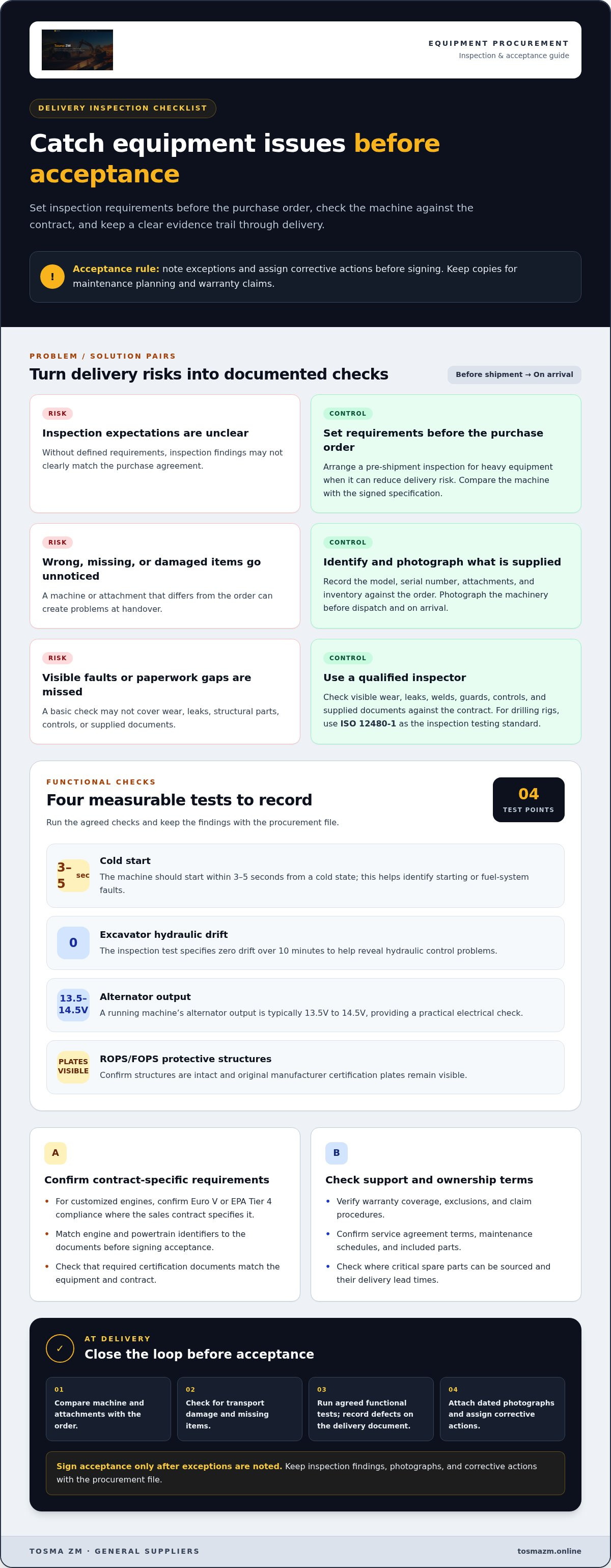
Set inspection requirements before releasing the purchase order. Arrange a pre-shipment inspection for heavy equipment when it can reduce delivery risk, and compare the machine with the signed specification. Record the model, serial number, attachments, and inventory against the order. Photograph the machinery before dispatch and on arrival to document any damage or missing items.
Use a qualified inspector to assess the vendor’s machine before shipment. Check visible wear, leaks, welds, guards, controls, and supplied documents against the contract. For drilling rigs, use ISO 12480-1 as the inspection testing standard. Keep inspection findings, photographs, and corrective actions with the procurement file, so acceptance has a clear evidence trail.
- Test the cold start. A construction machine should start within 3-5 seconds from a cold state, which helps identify starting or fuel-system faults.
- Check excavator hydraulics. The inspection test specifies zero drift over 10 minutes, helping reveal hydraulic control problems.
- Inspect protective structures. Confirm ROPS/FOPS structures are intact and original manufacturer certification plates remain visible.
- Measure charging output. A running machine’s alternator output is typically 13.5V to 14.5V, which provides a practical electrical check.
For customized engines, confirm Euro V or EPA Tier 4 compliance where the sales contract specifies it. Match the engine and powertrain identifiers to the documents before signing acceptance. A mismatch can affect the machine’s intended use and the capital committed to the purchase.
Verify warranty coverage, exclusions, claim procedures, service agreement terms, spare-parts access, and maintenance schedules. Confirm which parts are included, where critical items can be sourced, and their delivery lead times. These details affect downtime risk and the cost of keeping machinery operational.
At delivery, compare the machine and attachments with the order, then check for transport damage and missing items. Run the agreed functional tests, record defects on the delivery document, and attach dated photographs. Sign acceptance only after noting exceptions and assigning corrective actions. Keep copies for maintenance planning and any warranty claim.
Defining equipment requirements and specifications
Start with the work, not a machine model. Record the task, material type, site access, ground conditions, expected operating hours, and required output. For example, excavation in confined urban worksites calls for different reach and transport dimensions than bulk earthmoving. Include planned demand changes: industrial equipment buyers are advised to plan for 20-30% future expansion.
Give every supplier the same written specification. State the required capacity, operating weight, dimensions, power source, attachments, duty cycle, and site constraints. Add acceptance criteria and required documents, such as manuals, parts lists, and manufacturer certificates. Clear specifications reduce ambiguity between the offer, purchase order, and delivered machinery.
- Excavators: Define digging depth, reach, bucket capacity, operating weight, track width, and hydraulic flow. Match these numbers to excavation depth, haulage needs, and ground conditions.
- Cranes: Specify rated capacity at the required lift radius, boom configuration, hook height, and site setup limits. A maximum capacity alone won’t show whether the crane can perform the actual lift.
- Attachments: List coupler type, compatible tools, and hydraulic connections. This prevents a bucket or breaker from being unusable with the machine.
- Site readiness: Document access width, overhead restrictions, ground bearing conditions, and transport limits. These constraints can rule out otherwise suitable heavy equipment.
For projects in Zambia, include safety requirements in the tender, such as protective structures, guards, warning systems, and operator manuals. Specify training for the machine’s controls and tasks, and retain training records. Required certification documents should match the equipment, contract, and applicable site requirements.
A procurement checklist should cover the primary machine, attachments, transport equipment, and supporting plant needed for the job. Include spare parts and construction materials when they are part of the same work package.
Use project equipment requirements to structure a clear specification before inviting quotations.
Total cost of ownership
Compare equipment over its expected working life, not by purchase price alone. Total ownership cost includes acquisition, transport, fuel, operator time, maintenance, parts, downtime, and eventual resale or disposal. For projects in Zambia, account for the full delivery route and site conditions, which affect transport, operating demands, and how soon the machine can start work.
Estimate cost across the hours the machine will perform, then compare equivalent equipment and duty cycles. Typical economic life ranges are 10,000-15,000 operating hours for excavators, 12,000-18,000 for loaders, and 15,000-25,000 for cranes. Use these as planning references, not guarantees. Hard use, weak maintenance records, and demanding ground conditions can shorten service life.
- Acquisition and delivery: Record the quoted machine, attachments, freight, handling, and site delivery as separate line items, so each vendor’s offer is comparable.
- Operating costs: Estimate fuel use against expected workload and operating hours; compare engine efficiency under the same duty conditions.
- Maintenance and parts: Map scheduled servicing, consumables, critical parts, and sourcing time to the planned operating cycle.
- Downtime exposure: Include lost production when parts or specialist support are unavailable, especially for equipment on critical-path work.
Used equipment can cost 40-70% less than new equipment, and may avoid 20-30% first-year depreciation. Lower acquisition cost does not settle the comparison. A used Hitachi ZAXIS 200’s hydraulic pump failed six months after purchase; the machine remained out of service for 3 weeks while a replacement part was sourced. Review inspection records, testing results, component condition, and parts access before judging value.
For each option, calculate the expected cost per productive operating hour using the same workload assumptions. Separate known costs from estimates, then assess how lower efficiency or longer downtime would change the result. A construction equipment procurement checklist should record those assumptions alongside the supplier’s quote. Quality, compliance documents, and thorough inspection matter because a lower initial cost can lead to higher ownership costs.
Construction material and equipment management
Plan materials, machinery, and delivery as one site system. A loader arriving before aggregates or fuel storage is ready can sit idle, while materials without handling equipment can obstruct work areas. The difference between optimal and suboptimal equipment can produce a 20-40% productivity variance. Connect each machine to the actual material, task, storage point, and work sequence.
Build an inventory schedule for each work package. Match material type, quantity, delivery sequence, and storage location to the equipment that will handle it. Check compatibility between machinery and equipment from other suppliers, including couplers, attachments, and operating interfaces. The Food and Agriculture Organization of the United Nations (FAO) describes procurement checklists for market projects that may include equipment, machinery, and mechanical services such as environmental controls.
- Link orders to work stages: Schedule materials and equipment against the construction sequence, so critical items arrive before dependent tasks begin.
- Control site inventory: Record received quantities, assigned locations, and daily issues to identify shortages or excess stock.
- Coordinate logistics: Check route access, unloading space, and storage conditions before dispatch; these affect delivery timing and site congestion.
- Track utilization: Compare planned machine hours with actual use, then adjust dispatch or buying decisions when equipment sits idle.
For imports into Zambia, identify the machine’s classification, origin, intended use, and supporting documents before arranging customs clearance. Applicable taxes, permits, and standards depend on the equipment and transaction. Establish the requirements for the specific import rather than assuming one rule applies to every machine. Keep the resulting documentation with the purchase and delivery records.
The best supplier for a Zambian project is one whose equipment, documentation, delivery plan, and terms match the specification and site schedule. Compare written offers against those criteria, then verify that the proposed machinery integrates with existing inventory and work methods. ISO 20400 recommends considering environmental, social, and economic impacts alongside price and quality.
For coordinated equipment and material orders, plan your procurement requirements around the project sequence and site logistics.
Tosma ZM: Construction Supply
Tosma ZM’s Construction Supply is a practical next step once your project’s equipment and material requirements are clear. Use your specifications to define what the site needs, from construction materials to plant, and align procurement with the project schedule.
For projects that also require transport or specialist machinery, Tosma ZM offers Vehicles & Fleet and Mining Equipment. These categories can support procurement planning when commercial vehicles or mining machinery are part of the wider project requirements. Tie each request to its intended use, operating conditions, and delivery needs.
Prepare your equipment list, quantities, specifications, and delivery details before starting the procurement discussion. This gives your request a clear structure and connects supply needs to the work plan. Contact Tosma ZM to discuss your construction supply requirements.
Move Your Procurement Plan into Execution
Use your construction equipment procurement checklist as a working control document, not a file to set aside after approval. Assign responsibility for purchase decisions, delivery coordination, site readiness, and acceptance records. Keep updates visible to project, logistics, and finance teams so changes reach the people managing the work.
For projects in Zambia, Tosma ZM offers Construction Supply, Vehicles & Fleet, and Mining Equipment. These services support procurement when construction materials, commercial vehicles, or mining machinery are part of the project scope. A clear equipment list and delivery plan provide a practical starting point for the discussion.
Contact Tosma ZM about equipment procurement to discuss your project requirements. With a defined scope and an accountable procurement process, your team can move forward with greater operational clarity.
Frequently Asked Questions
What Is Construction Equipment Procurement?
Construction equipment procurement is the process of identifying, sourcing, purchasing, and bringing machinery into service for a project. A construction equipment procurement checklist helps teams make consistent decisions, from defining the operational need to recording approvals and delivery responsibilities. For example, a road project may require coordinated procurement of earthmoving equipment, haulage vehicles, and compatible attachments, rather than treating each purchase as a separate transaction.
How to assess construction equipment requirements and project specifications?
Assess requirements by mapping each machine to a specific task, work sequence, and site condition. For example, note whether an excavator must load trucks, trench beside existing services, or work on restricted-access routes. Identify who will operate it, how it connects with other machinery, and what documentation supports its use. This helps separate essential operating requirements from preferences that do not affect project delivery.
What should buyers check when comparing new, used, and rental construction equipment?
Compare new, used, and rental options against expected use, availability, condition, and responsibility for operating costs. New equipment may suit sustained utilization above 60-70%; used machinery can reduce initial capital needs but requires careful assessment of its history and condition. Rental may fit a defined, short-term task, but include mobilization, demobilization, and schedule constraints in the comparison. Keep the work scope consistent across each option.
What equipment inspection and testing should be done before purchase?
Before purchase, arrange an inspection suited to the machine type and intended work. Review service and ownership records, inspect wear components, and test controls under operating conditions. For a crane, assess the configuration against the planned lift; for a loader, check the bucket and attachment interface. Record observations, photographs, and agreed corrective actions in writing, so the purchase decision is based on evidence, not appearance alone.
What are the common risks and hidden costs when procuring construction equipment?
Common risks include specification mismatches, delivery damage, incomplete documentation, parts delays, and downtime caused by unsuitable equipment. Costs may also arise from freight handling, customs clearance, inland transport, storage, commissioning, operator familiarization, and idle time while a site is being prepared. For machinery imported into Zambia, identify these cost categories early and assign responsibility in the purchase documents. Compare the full delivered and operational scope, not just the machine quotation.


